Launch offer — valid today only

📄 Digital book in PDF · read it on your phone or print it

Test and Tag to AS/NZS 3760 in Drawings The Same 5 Steps on Every Item

Written for New Zealand: NZ plugs and cords, Class I and Class II, earth continuity, insulation resistance, polarity, tags, the register and re-test intervals. Every topic has its own page: the drawing first, then the values and steps you need to remember. 65 illustrated pages.

YES, SEND ME TEST AND TAG ILLUSTRATED

🔒 Secure checkout · PDF by email · 30-day guarantee

Every topic, its own pageEach test step drawn, with the explanation beside it
65 illustrated pages9 parts, from what test and tag actually is to the pre-audit check
Up-to-date sourcesAS/NZS 3760, WorkSafe NZ guidance and the Electricity (Safety) Regulations 2010
PDF by emailFormat

Look Inside the Book

Every page has one large drawing and a box with the values and steps you need to know:

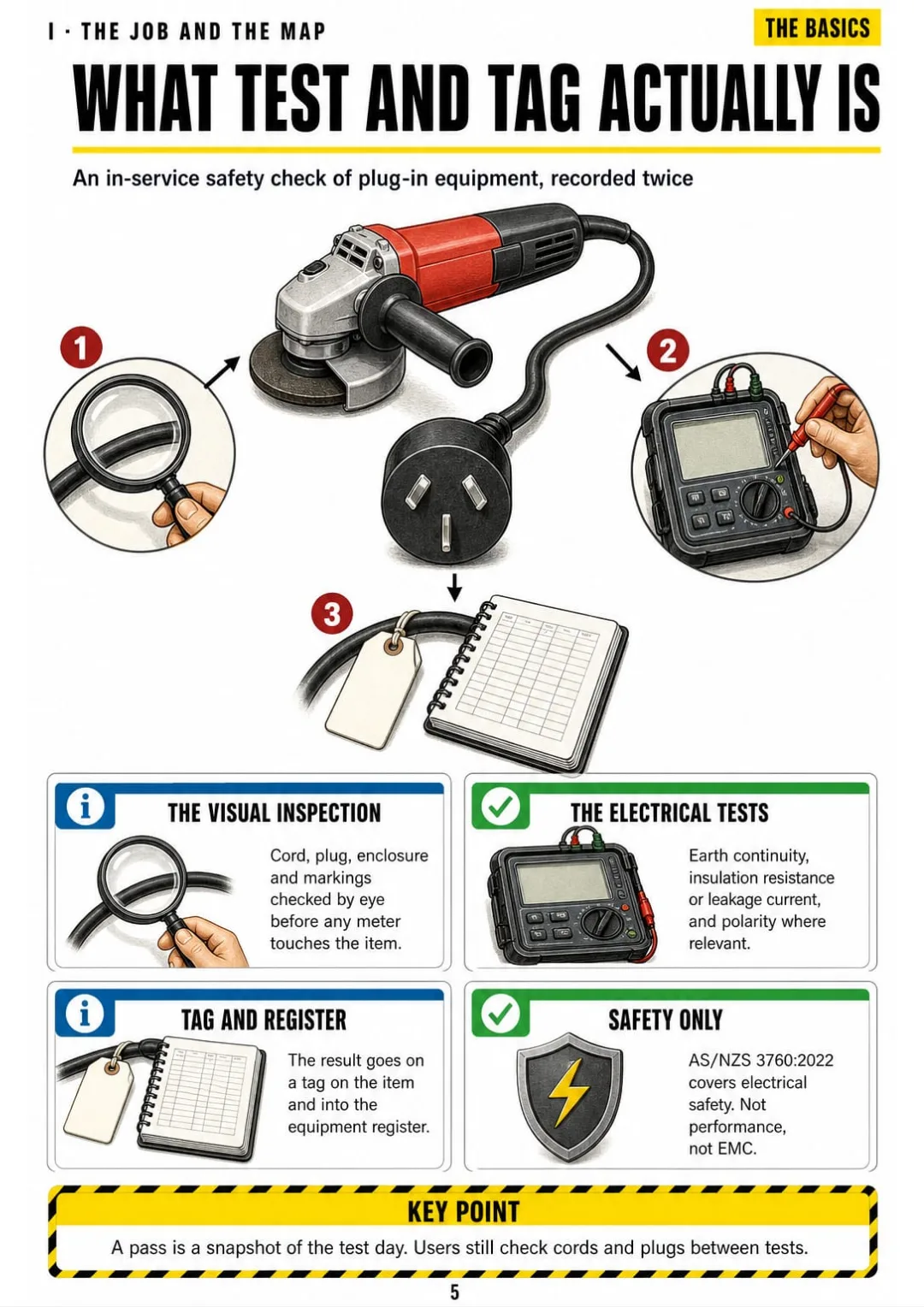
Visual inspection + electrical tests + tag + register: the four parts of every test and tag
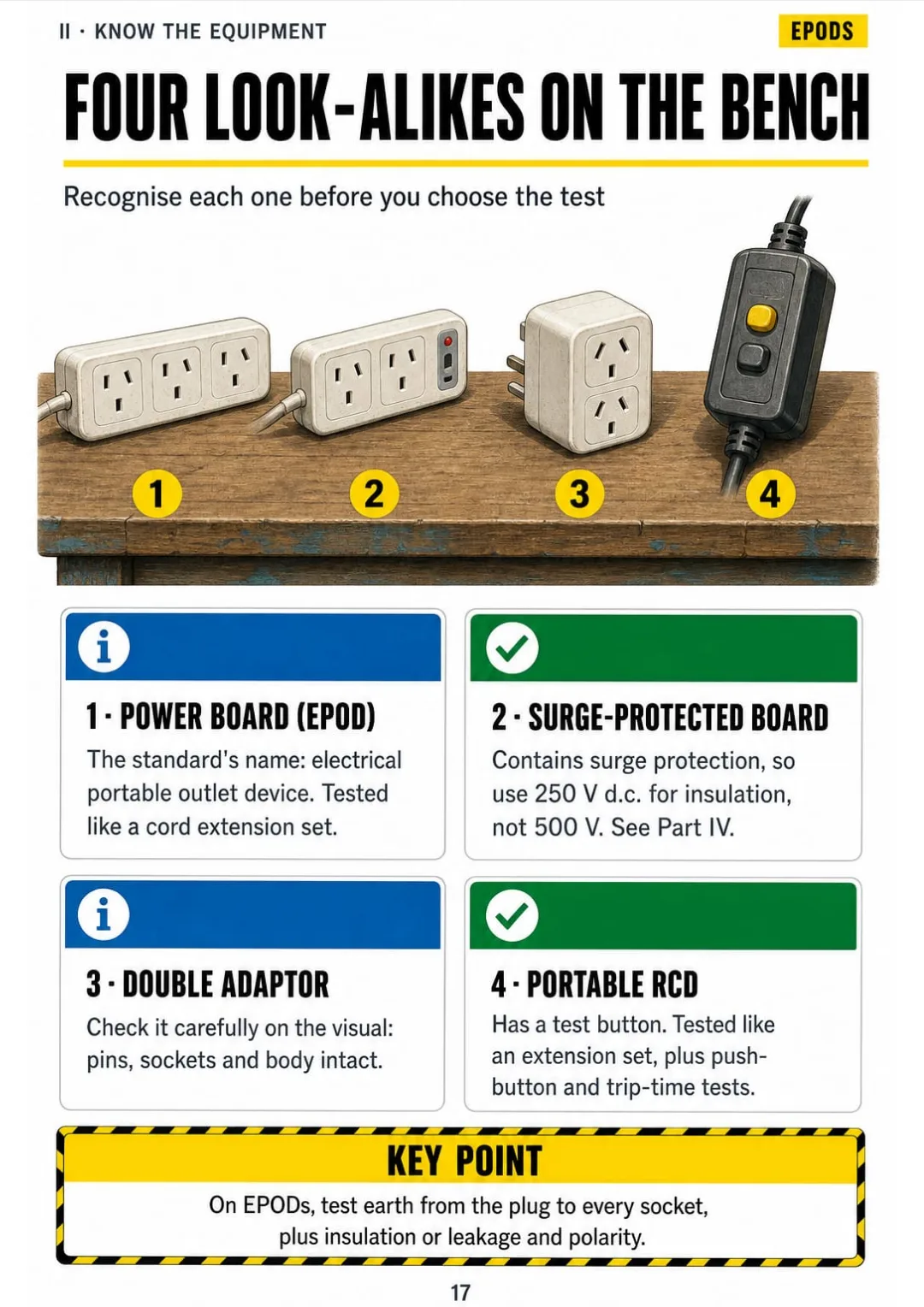
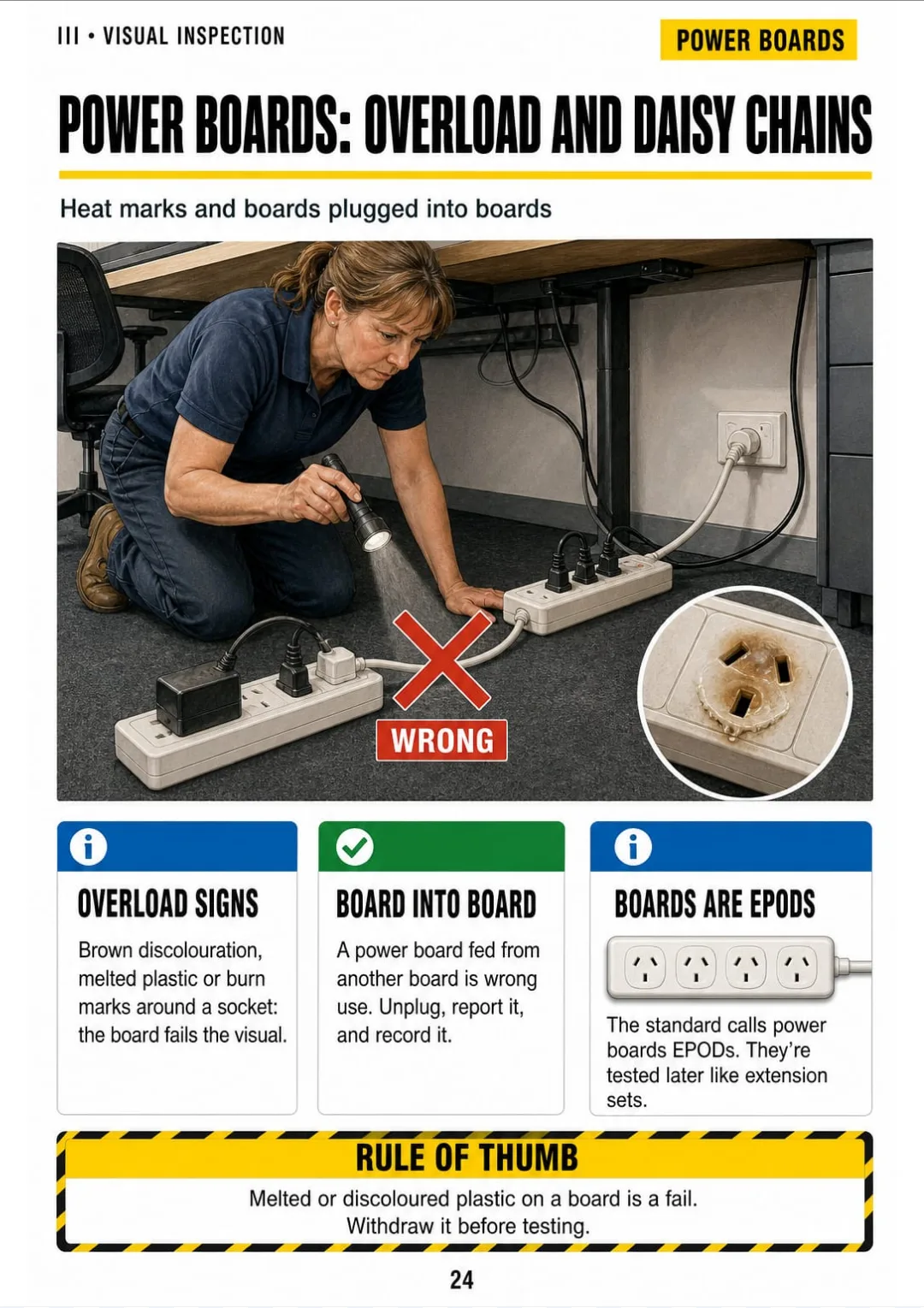
Power boards are EPODs: earth to every socket, and 250 V if there's surge protection
Discoloured or melted sockets fail; boards plugged into other boards are flagged as wrong use.
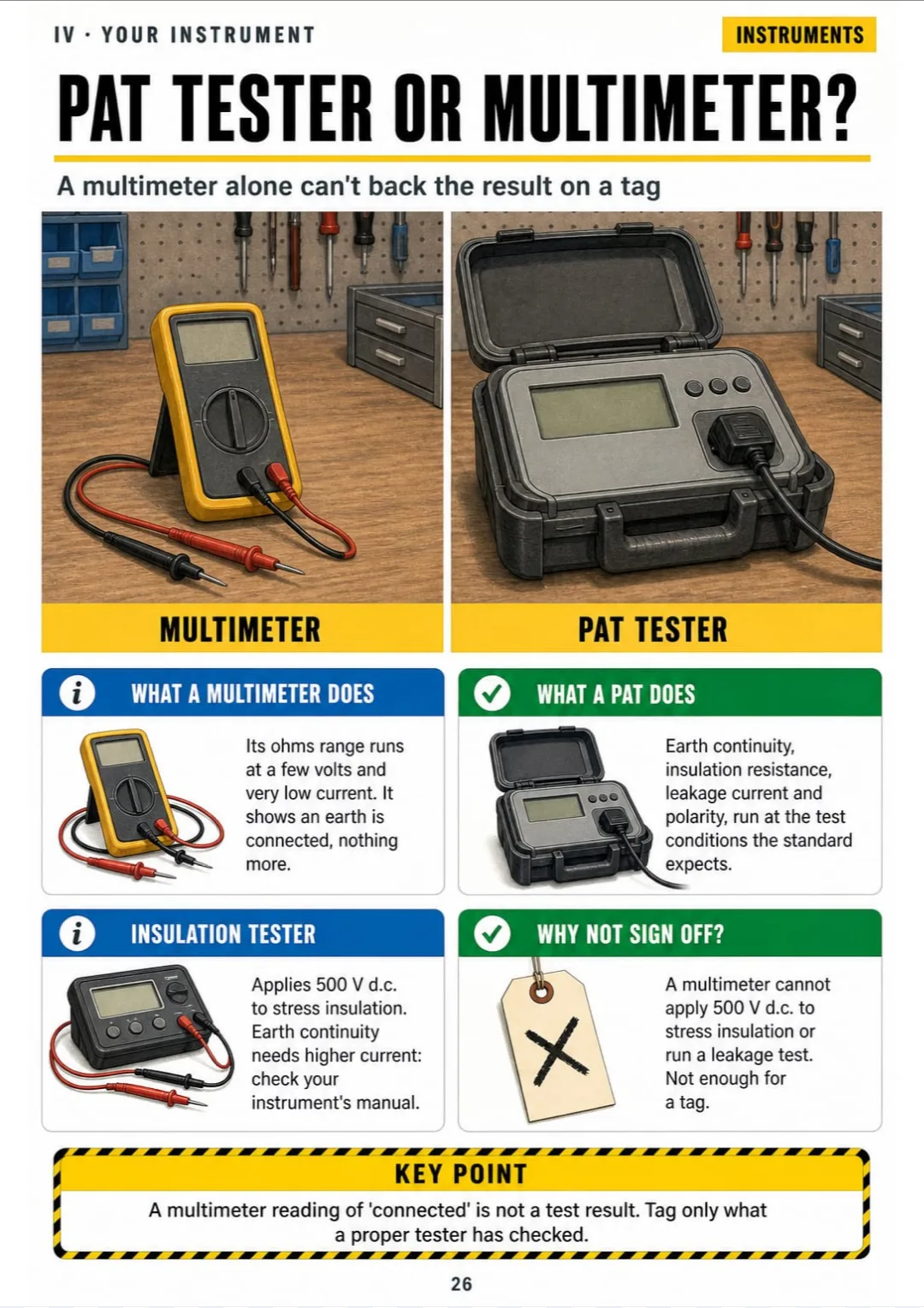
Multimeter: a few volts. PAT or insulation tester: 500 V d.c. for insulation.
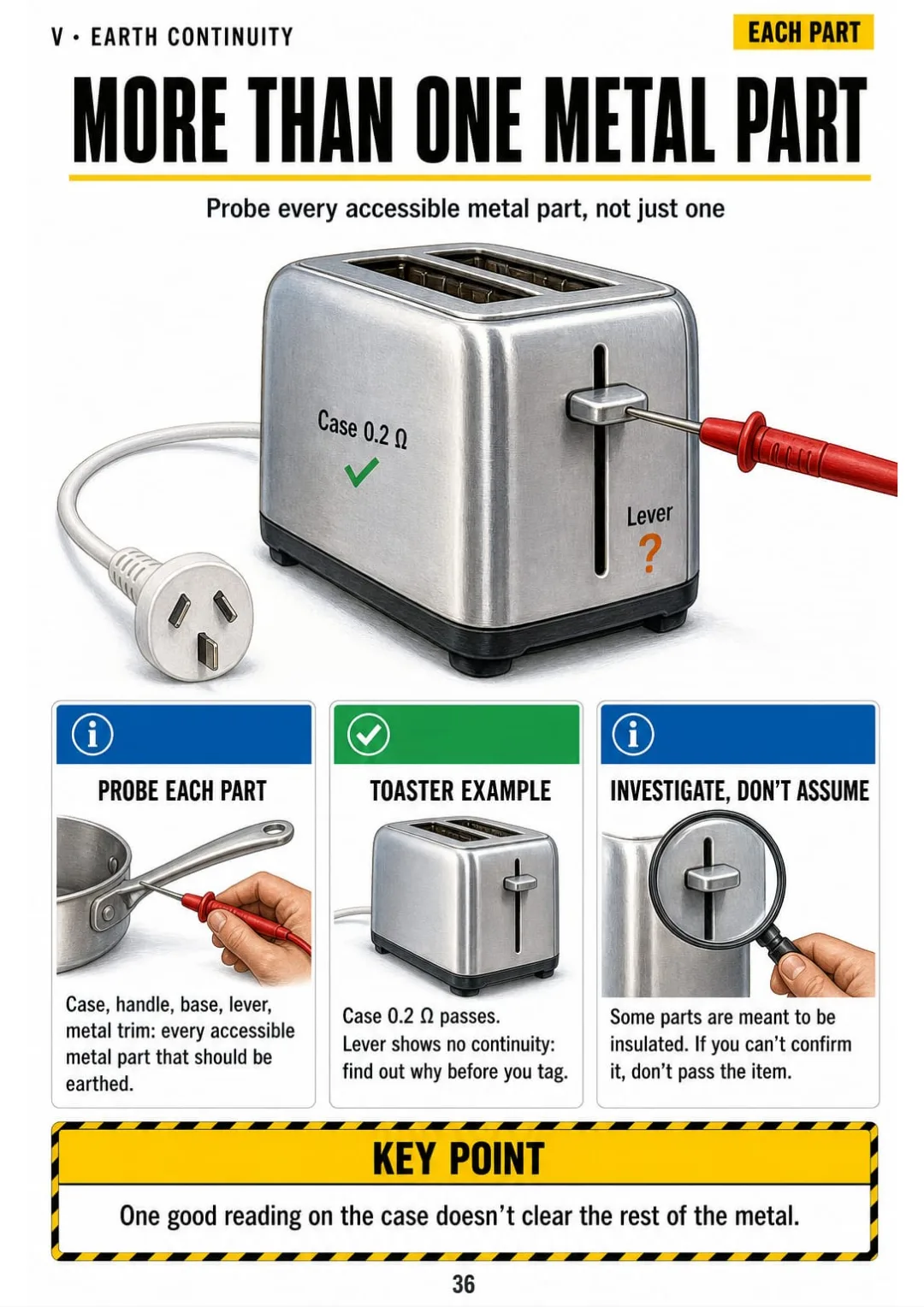
Toaster: case 0.2 Ω, lever no continuity, so investigate before you tag
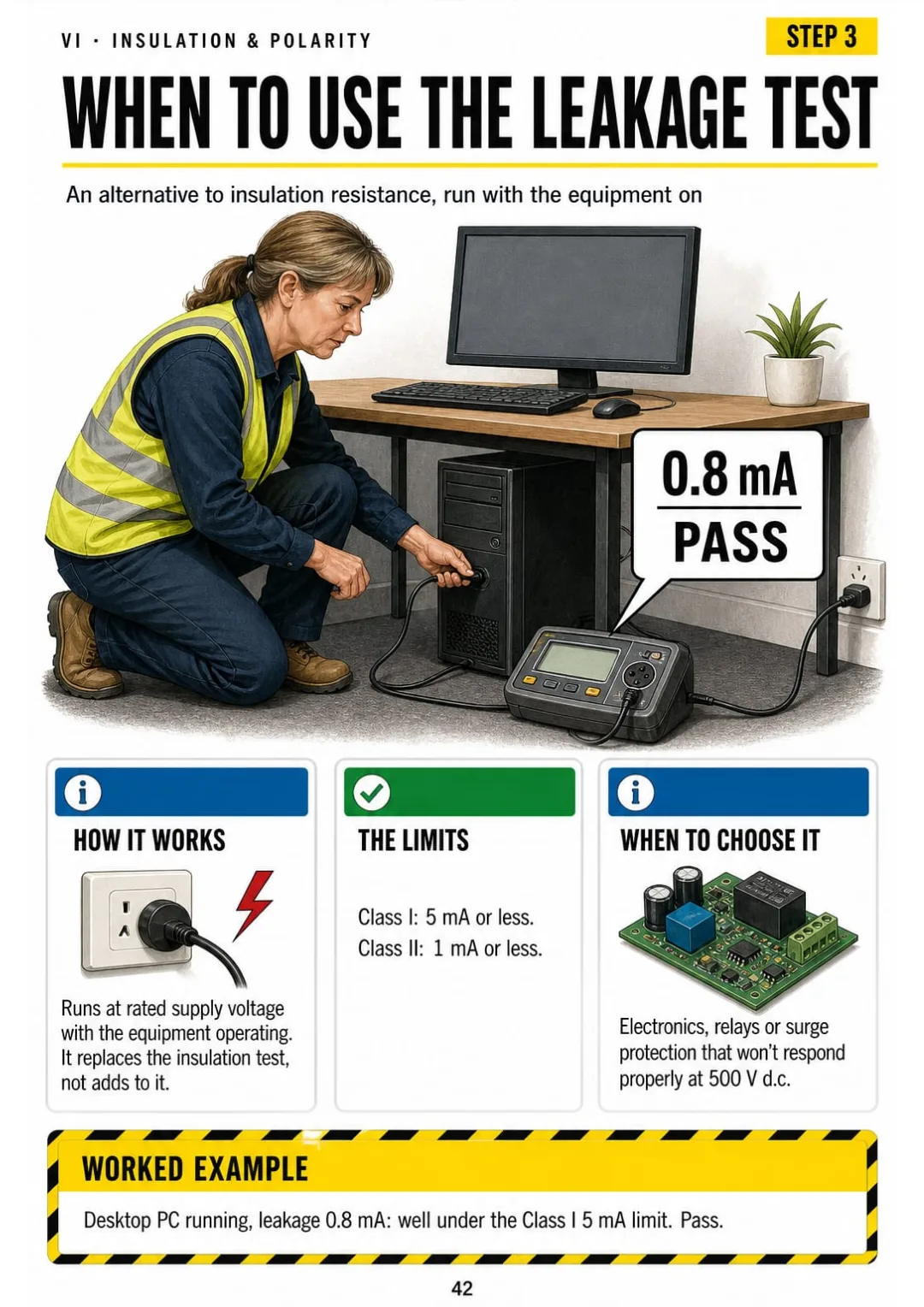
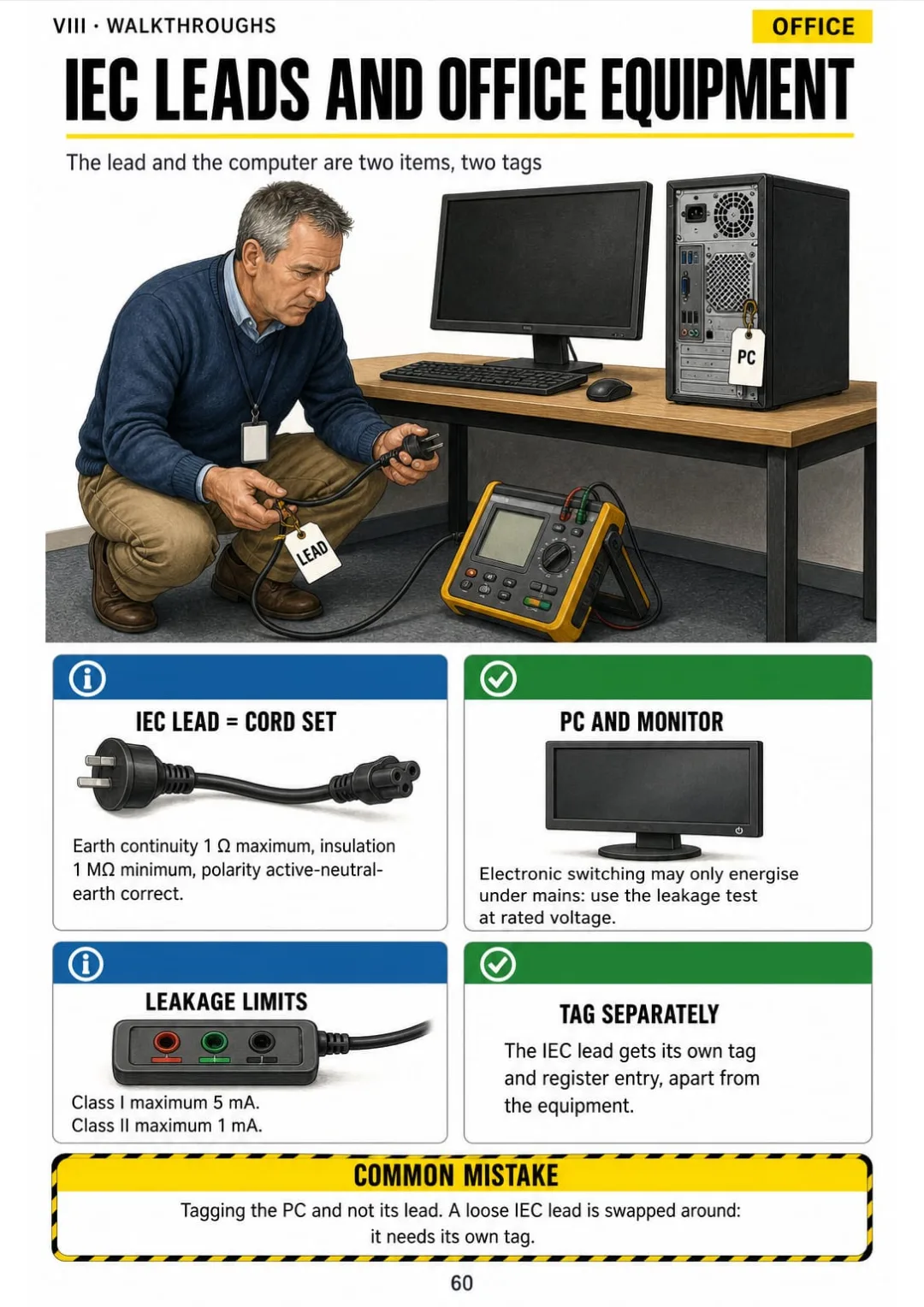
Leakage test with the item running: Class I ≤ 5 mA, Class II ≤ 1 mA
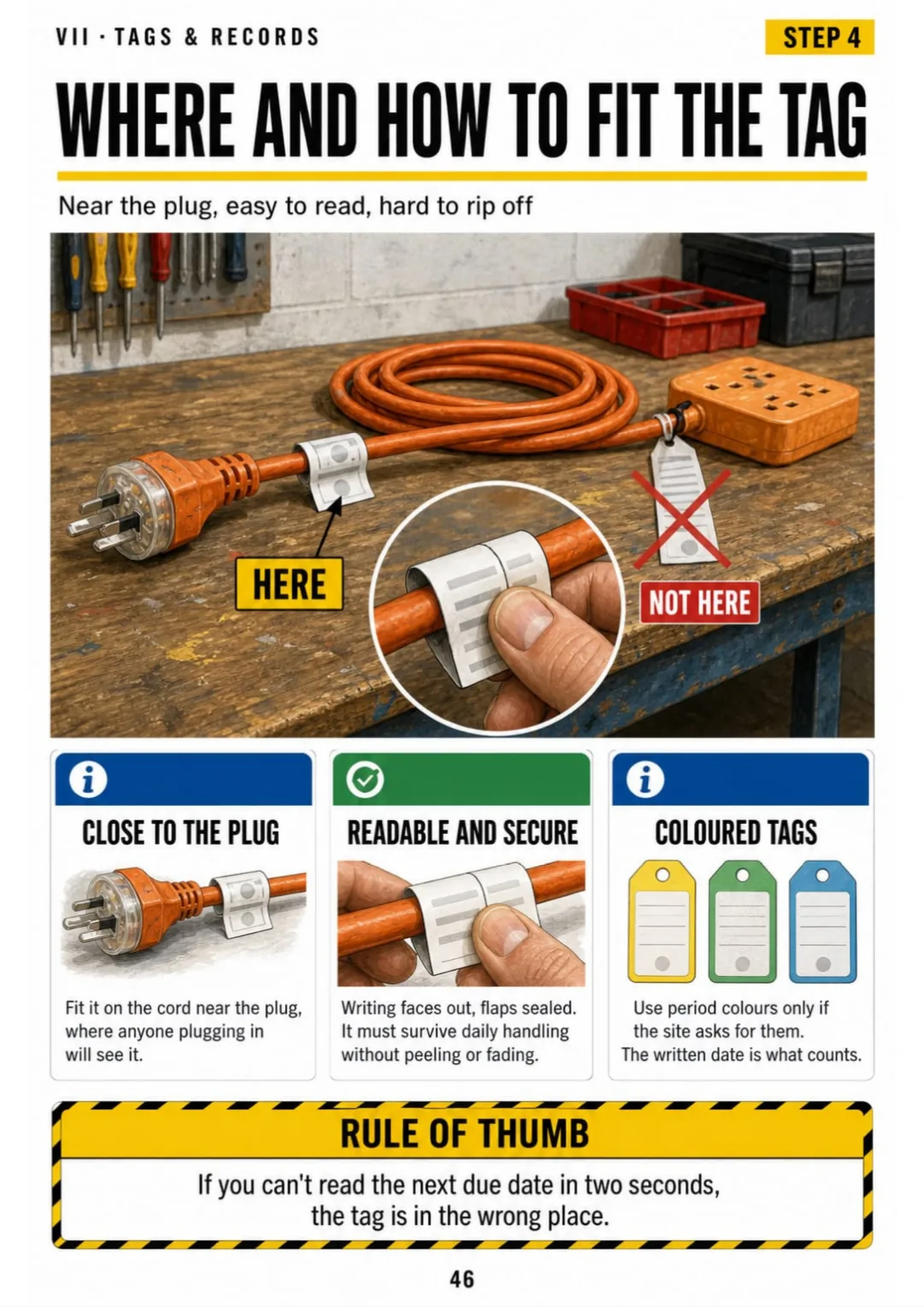
Tag near the plug, writing out, sealed: the date matters, not the colour
IEC lead tested as a cord set and tagged apart; PC and monitor checked with the leakage test.

Swipe to see more →

These are real pages from the book. The table of contents is the full one: 9 parts and 61 topics.

The Problem Isn't You. It's How It Was Explained.

You've got twenty leads and a grinder on the bench, and the instrument's already switched on. You run the earth test on the first lead and it reads fine. Then you spot the sheath split right where it meets the plug.

The standard covers the visual inspection in clauses and long lists. Nothing shows you where to look first, or why it comes before the meter. So the order slips every time you pick the job up again.

Discoloured or melted sockets fail; boards plugged into other boards are flagged as wrong use.

In the book, that topic is one page: a lead drawn from plug to socket, with arrows on the pins, the sheath, the cord anchorage at both ends and the casing. One look and you know what to check before you touch the test leads.

Earth continuity, insulation resistance, Class I versus Class II, what goes on the tag and the re-test intervals each get their own page too.

So you check each item in the right order, call pass or fail and fill in the tag without opening the PDF of the standard again.

COMPARE FOR YOURSELF

The Same Topic, Two Ways to Learn It

THIS
  • The manual: line after line
  • Class I and Class II explained only in words
  • You get to the bench still unsure
With Class I equipment, protection from shock depends on two things working together: the insulation around the live parts and a path to earth. Any metal the user can touch is bonded to the green/yellow conductor of the supply cord, which runs through the earth pin of the plug to the earth of the building's wiring, so that if the insulation breaks down the fault current has somewhere to go and the protective device can operate. For that reason a Class I item is checked for earth continuity as well as for insulation resistance, and where an insulation test is not suitable, a leakage current measurement may be taken instead.
FOR THIS
  • Class I earthing in one drawing
  • The tests for each class in a box
  • You see it and it makes sense
Power boards are EPODs: earth to every socket, and 250 V if there's surge protection
CONTENTS

Take a Look at the 9 Parts and 61 Topics

The job and the map, the equipment, visual inspection, your instrument, earth continuity, insulation and polarity, tags and intervals, worked walkthroughs and a quick review: 65 pages, all illustrated.

IThe Job and the Map · pp. 5-10
  1. What Test and Tag Actually Is
  2. Who Can Test and Tag in New Zealand
  3. Why the Business Has to Care
  4. What Is In Scope
  5. What Is Out of Scope
  6. The 5-Step Map You Will Use on Every Item
IIKnow the Equipment First · pp. 11-17
  1. Class I: Earthed Equipment
  2. Class II: Double Insulated
  3. When the Label Is Missing or Worn
  4. Class III, SELV and Chargers
  5. New Zealand Plugs and Sockets
  6. Flexible Cords and Conductor Sizes
  7. Power Boards, Adaptors and Portable RCDs
IIIStep 1: Visual Inspection · pp. 18-25
  1. Why the Visual Check Comes First
  2. The Plug: Pins and Body
  3. The Cord Sheath
  4. Cord Anchorage at Both Ends
  5. Enclosure, Guards and Switches
  6. Rating Label and Markings
  7. Power Boards: Overload and Daisy Chains
  8. Reading the Environment
IVYour Instrument · pp. 26-30
  1. PAT Tester, Insulation Tester or Multimeter?
  2. The Self-Check Before Every Session
  3. Calibration and the Instrument's Own Records
  4. 500 V or 250 V: Choosing the Test Voltage
  5. Setting Up the Leads Safely
VStep 2: Earth Continuity · pp. 31-36
  1. What the Earth Continuity Test Proves
  2. How to Run It
  3. The Pass Value: 1 Ohm
  4. Long Extension Cords Read Higher
  5. A Jumping Reading Is a Fail
  6. More Than One Metal Part
VIStep 3: Insulation, Leakage and Polarity · pp. 37-44
  1. What Insulation Resistance Proves
  2. Switch On Before You Test
  3. Class I Insulation: 1 Megohm
  4. Class II Insulation: Probe the Metal
  5. Heating Elements: The Known Exception
  6. When to Use the Leakage Test Instead
  7. Polarity on Extension Cords and Power Boards
  8. Three-Phase Equipment Basics
VIISteps 4 and 5: Tags, Records, Intervals and RCDs · pp. 45-54
  1. What Goes on the Tag
  2. Where and How to Fit the Tag
  3. Failed Item: Out of Service
  4. The Equipment Register
  5. New Equipment Entering Service
  6. How Intervals Are Decided
  7. Construction Sites: Every 3 Months
  8. Workshops, Offices and Hire Gear
  9. After Repair: Test Again
  10. Testing Portable RCDs
VIIIItem by Item: Worked Walkthroughs · pp. 55-60
  1. Extension Lead, Start to Finish
  2. Power Board With Surge Protection
  3. Class II Angle Grinder
  4. Class I Kettle
  5. Battery Charger and Cordless Tools
  6. IEC Leads and Office Equipment
IXQuick Review and Common Mistakes · pp. 61-65
  1. The 5 Steps on One Page
  2. Pass Values at a Glance
  3. Common Mistakes on the Bench
  4. Common Mistakes on the Tag and Register
  5. Before an Audit: 6 Things to Check

One Page, One Topic, All Clear

Think of it this way:

It's Monday, the site manager wants every lead on the new job tagged before lunch, and the first one you pick up is a 20 m extension lead.

You open the book at the extension lead page and see it drawn start to finish: the visual check, earth at 0.31 Ω, insulation over 100 MΩ, polarity correct, each reading next to the pass value it has to meet, then the tag and the line in the register. The whole lead, in the order you test it.

Toaster: case 0.2 Ω, lever no continuity, so investigate before you tag

Same for the Class II angle grinder, the Class I kettle, the power board with surge protection and the battery charger: each one on its own page.

Test and Tag Illustrated is 9 parts and 61 topics, all drawn, finishing with the pass values at a glance and the common mistakes on the bench, the tag and the register.

What you see drawn, you don't have to memorize.

What's Inside Test and Tag Illustrated:

Ipp. 5-10

The Job and the Map

What test and tag actually is, who can do it in New Zealand, why the business has to care, what's in and out of scope, and the 5-step map you use on every item. You know where you're going before you pick up the first lead.

IIpp. 11-17

Know the Equipment First

Class I, Class II and Class III, what to do when the label is missing, New Zealand plugs and sockets, flexible cords and conductor sizes, power boards and portable RCDs.

IIIpp. 18-25

Step 1: Visual Inspection

Why the visual check comes first, then the plug, the cord sheath, cord anchorage, enclosure and switches, rating labels, overloaded power boards and the environment.

IVpp. 26-30

Your Instrument

PAT tester, insulation tester or multimeter, the self-check before each session, calibration, 500 V or 250 V, and setting up the leads safely.

Vpp. 31-36

Step 2: Earth Continuity

What the earth continuity test proves, how to run it, the 1 ohm pass value, why long leads read higher, jumping readings and items with more than one metal part. So a long lead or a reading that jumps never leaves you unsure whether to pass it.

VIpp. 37-44

Step 3: Insulation, Leakage and Polarity

Insulation resistance, switching on before you test, Class I and Class II limits, heating elements, when to use the leakage test, polarity and three-phase basics.

VIIpp. 45-54

Steps 4 and 5: Tags, Records, Intervals and RCDs

What goes on the tag and where it goes, failed items, the equipment register, new equipment, how intervals are set, construction sites, workshops, hire gear, re-testing after repair and portable RCDs.

VIIIpp. 55-60

Item by Item: Worked Walkthroughs

Six items tested start to finish: an extension lead, a surge-protected power board, a Class II grinder, a Class I kettle, a battery charger with cordless tools and IEC leads.

IXpp. 61-65

Quick Review and Common Mistakes

The 5 steps on one page, the pass values at a glance, common mistakes on the bench and on the tag and register, and 6 things to check before an audit.

At the end of the book: 6 items tested start to finish and the pass values on a single page.
Plus: 2 Free Books

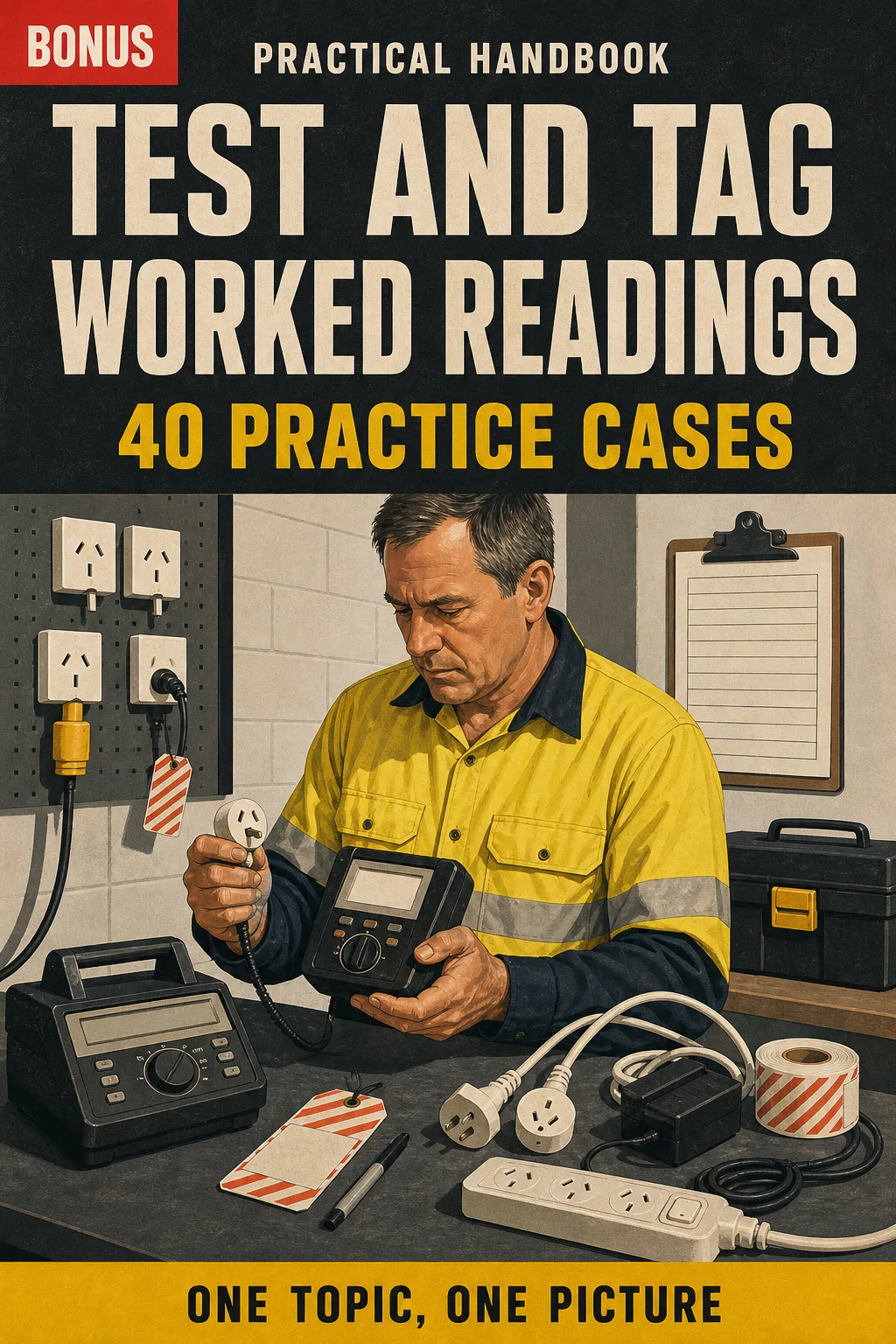
Test and Tag Worked Readings: 40 Practice Cases

BONUS 1: «Test and Tag Worked Readings: 40 Practice Cases»

Value on its own: US$ 17.90

Practise reading real earth continuity and insulation results on leads, tools and appliances, and decide pass or fail before you're standing in front of the pile.

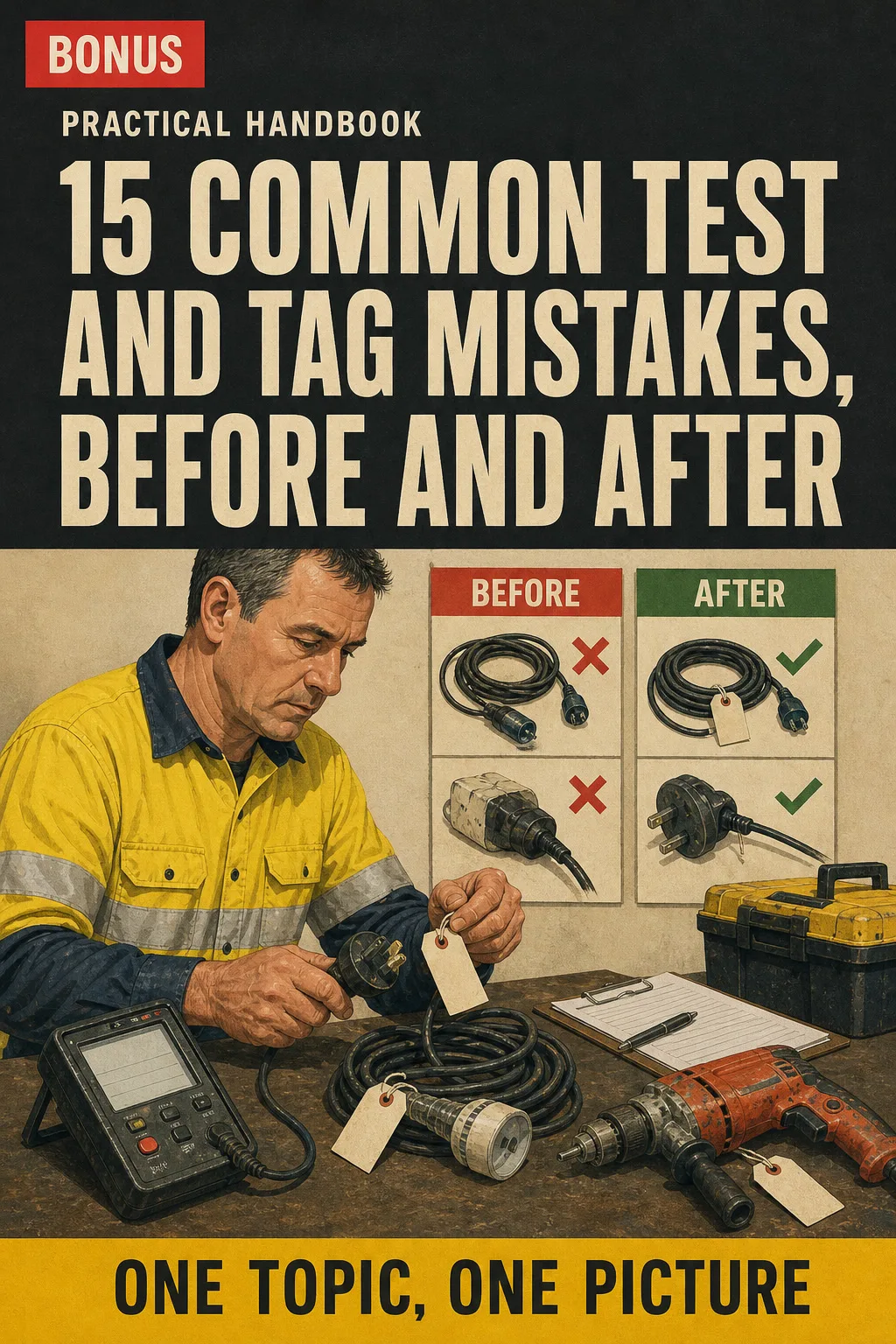
15 Common Test and Tag Mistakes, Before and After

BONUS 2: «15 Common Test and Tag Mistakes, Before and After»

Value on its own: US$ 14.90

The most frequent slip-ups, from the wrong tag colour to skipping the instrument self-check, each drawn side by side with the right way, on printable cards.

Test and Tag Illustrated with 2 Free Books

  • Test and Tag Illustrated: 65 illustrated pagesUS$ 63
  • BONUS 1: Test and Tag Worked Readings: 40 Practice CasesUS$ 17.90
  • BONUS 2: 15 Common Test and Tag Mistakes, Before and AfterUS$ 14.90
  • High-resolution PDF to printIncluded
Total value US$ 95.80
YOUR PRICE:
US$ 27
You save US$ 68.80
YES, I WANT TEST AND TAG ILLUSTRATED FOR US$ 27

📄 This is a digital PDF book sent to your email: nothing is printed or shipped.

Secure purchaseEncrypted payment30-day guarantee

PDF by email: We email you Test and Tag Illustrated as a PDF, together with the two free books. It's a single payment: no installments, no extra charges.

Who This Book Is For

You've just been handed the testing job

You've just been handed the testing job

The 5-step map and one page per topic show you the whole routine in order, from the plug check to the register line, without starting from the standard.

A re-test round or an audit is coming

A re-test round or an audit is coming

The pass values, the tag contents and the intervals are drawn on their own pages, so you can check your records and tags before anyone else does.

You're a sparky who tests now and then

You're a sparky who tests now and then

You know the tools; the book gives you the order and the numbers back in a glance, printed and kept in the van.

Everything You Get Today

US$ 95.80US$ 27
YES, I WANT TEST AND TAG ILLUSTRATED FOR US$ 27

📄 This is a digital PDF book sent to your email: nothing is printed or shipped.

30DAYS
GUARANTEE

30-Day Guarantee

Try Test and Tag Illustrated for 30 days, bonus books included.

We refund everything if the file won't open, if the book isn't what you see here, if you were charged twice or if the email doesn't arrive. Just email us.

You pay once. No subscriptions.

Frequently Asked Questions

Is it for me if I already test and tag now and then?

Yes. It isn't a beginner's course: it's the routine laid out in the same order every time, with the values and tag details on their own pages, for when you pick the job up again after a few months.

Is it written for New Zealand, and are the values up to date?

It's written for New Zealand: NZ plugs, sockets and cords, NZ terms and the Electricity (Safety) Regulations 2010. It isn't a UK PAT guide or a generic Australian one. The values, tag details and intervals are checked against AS/NZS 3760:2022 and WorkSafe New Zealand guidance. The standard isn't reproduced: it's explained in drawings and plain words.

Is it official material?

No. It's an independent illustrated book. It isn't published, endorsed or approved by Standards New Zealand, Standards Australia or WorkSafe New Zealand.

Does it replace a test and tag course or training?

No. It's a study and reference book. It doesn't qualify you to test and tag, and it doesn't replace training, competency requirements or your instrument's manual.

Are the practice readings taken from a real assessment?

No. The 40 practice cases are written for this book, so you can practise calling pass or fail. They aren't questions from any official course or assessment.

When and how does it arrive?

The book and the 2 free books arrive as PDFs by email, to the address you enter when you pay.

Do I have to pay every month?

No. It's a one-off payment, with no subscription.

Can I have it on paper?

Yes. The PDF prints on A4, so you can print the pages you need and keep them in the van or the workshop.

How does the refund work?

You have 30 days. We refund everything if the file won't open, if the book isn't what you see on this page, if you were charged twice or if the email doesn't arrive: just email us.

Before You Close This Page

No more rereading the standard and losing it by the next job.

Class I or Class II, you see it drawn and that's it.

You walk up to the pile of leads knowing where everything is.

Drawings make studying faster.

The book is right below.

One-time payment: US$ 27 · Guarantee: 30 days · PDF by email

YES, I WANT TEST AND TAG ILLUSTRATED FOR US$ 27

📄 This is a digital PDF book sent to your email: nothing is printed or shipped.